Product Updates

Follow new updates and improvements to ecosio.

March 2nd, 2026

Public

The United Arab Emirates is launching a mandatory e-invoicing system for all VAT-registered businesses engaging in B2B and B2G transactions, with Phase 1 enforcement starting July 2026. This five-corner continuous transaction control (CTC) model requires real-time reporting to the Federal Tax Authority (FTA) and structured invoice exchange via Peppol.

With Global E-invoicing Compliance, we are building support for the UAE so you can meet these requirements through one managed connection.

Why the UAE mandate is different

The UAE's system introduces a multi-step compliance process:

  • Dual delivery requirement: every invoice must be reported to the FTA via a Tax Data Document (TDD) and sent to your trading partner via Peppol as UBL 2.1, two separate but coordinated flows.

  • Accredited service provider requirement: only accredited service providers can issue, transmit and report invoices. You cannot connect directly to the FTA or Peppol network on your own.

  • Cross-border handling: exports must be reported to the FTA even when overseas buyers are not on the UAE Peppol network.

    Managing this in-house means establishing a legal entity, achieving accreditation, and maintaining two delivery flows, which is a significant burden for a single country mandate.

What we are building for you

With Global E-invoicing Compliance, we are designing UAE support to handle both Peppol exchange and FTA reporting in one coordinated process:

  • Dual delivery in one flow: route invoices to trading partners via Peppol and submit compliant TDD data to the FTA through a single connection.

  • Built-in AE PINT transformation: transform invoices, credit notes and self-billed invoices into compliant UBL 2.1 and validate all tax-related fields before submission.

  • Accredited service provider status: leverage our ASP accreditation to avoid legal entity setup, capital requirements and ongoing compliance obligations.

Ready to dive deeper?

The July 2026 deadline means you need to start planning now to avoid last-minute integration issues and compliance penalties.

The ecosio Product team
February 27th, 2026

Public

Germany is in the middle of a phased B2B e-invoicing rollout. Since 1 January 2025, businesses established in Germany must be able to receive and process structured electronic invoices for domestic B2B transactions.

Germany’s approach is currently focused on digitisation between trading partners, without mandatory, real-time invoice clearance by the tax authority. That said, requirements are expected to evolve over time as Germany aligns with EU ViDA and future digital reporting requirements ahead of the 1 July 2030 deadline.

Timeline for Germany

  • 1 January 2025: All domestic businesses must be able to receive and process structured e-invoices (domestic B2B).

  • End of 2026: End of transition period for “other invoices” (for example paper and non-compliant PDFs).

  • 1 January 2027: Domestic businesses with annual turnover over €800k must issue structured e-invoices.

  • 1 January 2028: All domestic businesses must issue structured e-invoices.

What you must know about Germany

  • Scope and model: The mandate applies to domestic B2B transactions between German-established entities. Invoice exchange is decentralised (supplier and buyer model). There is no central B2B platform today.

  • Format requirements (EN 16931): Structured e-invoices must comply with EN 16931.

    • Common syntaxes: UBL, Peppol BIS and UN/CEFACT CII. xRechnung for B2G.

    • ZUGFeRD is also permitted (hybrid PDF/A-3 with embedded XML), provided it is EN 16931-compliant.

  • What changes in practice (2025–2026): Paper, PDFs, and other non-EN 16931 electronic formats are treated as “other invoices”. They are allowed during the transition, but will no longer be valid after 2026.

  • Transmission protocols: Recipients must provide an email inbox for receipt of e-invoices. Trading partners can agree alternative transmission methods such as Peppol, AS2, SFTP, or providing invoices for download via a customer portal.

  • Storage and audit readiness: E-invoices must be stored to ensure authenticity of origin, integrity of content, and legibility. In practice, organisations should plan for long-term archiving obligations (commonly 10 years).

  • Regulatory direction: The mandate was formalised through the Growth Opportunities Act, with additional clarification published by the German Federal Ministry of Finance (BMF) (draft guidance issued in 2024) on how e-invoices should be issued and handled.

How a managed compliance service helps

For large organisations, the main risk is not only meeting a single mandate, but maintaining a scalable approach across formats, protocols, partner variability, and ongoing regulatory change.

With ecosio’s managed compliance service for e-invoicing, we help teams:

  • Connect once via a single gateway to exchange e-invoices with customers, suppliers, and networks.

  • Keep formats compliant through validation and conversion, including EN 16931-aligned handling.

  • Support multiple transmission options (email-based receipt, Peppol, AS2, SFTP, and more) based on each partner’s capability.

  • Stay future-ready as Germany’s model moves towards broader EU digital reporting expectations.

Want to know more about Germany? Have a deeper look into this country in our country profile page, our FAQ has been especially popular for answering common questions about this mandate. In case you’re ready to discuss how ecosio can help your specific business case for Germany and many other countries, get in touch today!

The ecosio Product Team

February 24th, 2026

General Public Documentation

Public

If you are a white-label partner, your growth often hits a predictable ceiling. As you take on more customers, your team spends more time juggling timelines and chasing simple setup steps like account creation or connector status checks. You are ready to deliver, but you are stuck waiting for a ticket to clear someone else's queue.

The latest updates to the Monitor and Connect remove these hurdles by giving you both the visibility and the tools to act independently. The new Customers Overview in the Monitor provides a single source of truth for your entire portfolio. You can instantly see every client environment, track connector counts, and see assigned consultants across hundreds of accounts without switching views.

To turn that visibility into action, the Management API within Connect lets your team programmatically handle core onboarding steps. You can build three-level company hierarchies, create accounts, and roll out e-invoicing countries in minutes rather than hours.

How this changes your day-to-day:

  • Eliminate delivery stalls: By using the API to automate routine setups, you cut out the handoffs that usually add days to a project timeline.

  • Spot issues before clients do: The consolidated Customers tab ensures you see a connection gap across your portfolio before it becomes a support ticket.

  • Autonomy with a safety net: You control the timing and repeatability of the rollout, while ecosio maintains the high-level quality control and operational monitoring in the background.

This isn’t about simple automation, it is about ensuring your delivery team keeps its momentum so you can scale your partner ecosystem with confidence.

Discover how ecosio simplifies global e‑invoicing compliance at ecosio.com or or get in touch with our experts today.

The ecosio Product team
February 18th, 2026

Public

The Philippines is rolling out a mandatory electronic invoicing system that will reshape how in-scope taxpayers issue and report invoices. Instead of only sending a document to your customer, you now need to ensure that the same data reaches the Bureau of Internal Revenue (BIR) in the prescribed JSON format and through the national Electronic Invoicing System (EIS).

With Global E‑invoicing Compliance, we are building support for the Philippines so you can prepare for the 31 December 2026 deadline and subsequent expansion phases without introducing extra portals, manual workarounds, or custom integrations.

Why the Philippines is different

The Philippines has adopted a clearance‑based model centred on the BIR's EIS platform. Rather than simply archiving invoices for later reporting, relevant transaction data must be sent in real time or near real time to the tax authority using a standard JSON schema and digital signatures. That means:

  • E‑invoicing applies across B2B, B2C and B2G transactions

  • A defined set of document types is in scope, including sales invoices, service billings, credit and debit notes, export invoices, nominal invoices and official receipts

  • In‑scope taxpayers must register and complete a certification process with the BIR before they can start transmitting through EIS

  • Non‑compliance can trigger financial penalties, delayed VAT processes and increased audit risk

  • Businesses must retain e‑invoice data for 10 years in a secure, accessible format, while managing parallel requirements such as local archiving, QR codes, and separate delivery of readable invoice copies to buyers

What we are building for you

With Global E‑invoicing Compliance, we are designing Philippines support to handle both commercial invoice delivery and EIS reporting through a single, coordinated flow. This includes:

  • Connect your existing ERP or invoicing landscape to BIR's EIS using a single connection

  • Transform supported document types into the required JSON format and apply the necessary JWS electronic signature

  • Send transaction data to EIS for clearance and, in parallel, deliver readable invoices to your customers via the preferred channel

  • Handle domestic B2B, B2C and B2G flows as well as exports within a unified setup

  • Track submission status, acknowledgement identifiers and error messages in one place

What to do next

If you fall under the first wave of in‑scope taxpayers in the Philippines, or expect to be included in later phases, now is the time to prepare. Registration, certification, testing and internal process changes all take time, and early movers will be better positioned once the 31 December 2026 deadline approaches.

For a detailed breakdown of the Philippines' e‑invoicing requirements, visit our dedicated e‑invoicing in the Philippines page. If you are ready to explore how we can help you manage Philippine e‑invoicing as part of a broader global strategy, contact our sales team today.

The ecosio Product team
February 10th, 2026

Public

We are excited to announce that we have successfully achieved accreditation from the Ministry of Business, Innovation and Employment (MBIE) and are officially a certified Peppol Access Point in New Zealand. This milestone enables enterprises to meet New Zealand's B2G mandate and voluntary B2B e-invoicing requirements through Global E-invoicing Compliance.

With our New Zealand accreditation now live, businesses can seamlessly exchange e-invoices with government agencies and private sector trading partners across the Peppol network, helping you future-proof your APAC e-invoicing strategy as adoption continues to expand across the region.

What New Zealand accreditation means for your business

New Zealand is advancing its digital economy through a "Government First" strategy. Since July 2022, all central government agencies have been required to receive e-invoices via the Peppol network. From 2026 onward, e-invoicing is becoming the default payment method for public sector entities, with agencies required to pay e-invoices within 5 to 10 business days.

While B2B e-invoicing remains voluntary, businesses are increasingly adopting Peppol to unlock faster payments, reduce manual errors, and streamline financial processes. New Zealand and Australia share the same Peppol infrastructure, enabling seamless Trans-Tasman e-invoicing through a single Access Point.

How Global E-invoicing Compliance simplifies New Zealand e-invoicing

With Global E-invoicing Compliance, you can meet New Zealand's B2G and B2B requirements without additional point-to-point integrations. Our solution provides:

  • Certified MBIE accreditation ensuring compliance with New Zealand's security and governance requirements

  • PINT A-NZ format expertise handling the mandatory standard for all Peppol transactions

  • Global coverage enabling you to manage New Zealand e-invoicing alongside any other countries where you operate through one single platform

Ready to connect?

Visit our New Zealand country page for detailed technical specifications, or contact our sales team today to secure your connection and ensure your business is fully compliant with New Zealand standards.

The ecosio Product team

February 5th, 2026

Public

Your business already navigates Serbia's SEF e‑invoicing mandate, but now, with e‑transport requirements launching in phases, you need a solution that scales without adding complexity. Here's the good news: Global E-invoicing Compliance can now deliver both SEF and SEO connectivity through a single integration point. You won't need to juggle multiple vendors or rebuild your infrastructure.

What you're managing in Serbia

Serbia's digital compliance landscape includes two parallel systems: SEF handles structured e‑invoicing in UBL 2.1 format with clearance workflows and 10‑year archiving, while SEO introduces mandatory e‑transport documentation. The SEO rollout began in January 2026 for public sector deliveries and excise goods, expanding to all B2B shipments by October 2027.

Why a unified approach beats point solutions

Companies often face a choice: work with separate local vendors for each mandate, or extend their middleware every time requirements change. Global E-invoicing Compliance offers a third path. A single managed integration handles both your invoice and e‑transport document flows to SEF and SEO, giving you:

  • Immediate compliance with current B2B and B2G e‑invoicing rules, plus seamless support as e‑transport scope widens

  • Consistent UBL 2.1 processing for both invoice and transport documents through one connection layer

  • Built‑in validation, signing, and routing logic that aligns with government platform requirements

  • Reduced risk of submission errors, missed deadlines, and audit complications

The compliance clock is ticking

With e‑invoicing already enforced and the first e‑transport deadline already behind us, the window to prepare is narrow. A unified connection reduces implementation time, eliminates the need for ongoing vendor coordination, and keeps your team focused on business operations rather than compliance firefighting.

Take the next step

Visit our comprehensive Serbia compliance guide to review mandate timelines, technical requirements, and frequently asked questions: E‑invoicing in Serbia

Or speak with our team to map out a compliance strategy tailored to your systems and transaction volumes: Get in touch

The ecosio Product team

January 23rd, 2026

Public

France is entering a major shift in how B2B invoicing and transaction reporting will work at scale. The new “Y-Model” framework introduces stricter governance, platform accreditation, and production-grade exchange requirements. For any business operating in France, this is a compliance programme that needs proper planning, real testing, and an accredited partner that can support you from early preparation through to mandate go live.

From 𝗦𝗲𝗽𝘁𝗲𝗺𝗯𝗲𝗿 𝟮𝟬𝟮𝟲, all VAT-registered businesses established in France must be able to 𝗿𝗲𝗰𝗲𝗶𝘃𝗲 e-invoices. E-invoicing and e-reporting issuance obligations also start for large and mid-sized companies, then extend to all businesses a year later, in September 2027.

ecosio has been working hard to build solid value for companies needing e-invoicing in France, and has officially certified as a Plateforme Agréée in France.

ecosio has been officially accredited as a Plateforme Agréée (PA) in France.

What makes France different

France’s approach raises the bar in a few important ways:

  • A controlled platform ecosystem: only accredited platforms can exchange e-invoices between companies and connect to the Tax Authority portal to report them.

  • Dual scope: the framework covers e-invoicing and e-reporting, so compliance touches more than invoice formatting alone.

  • Production expectations: As processes and controls need to be tested and work with real operational data, a 𝗽𝗶𝗹𝗼𝘁 𝗽𝗵𝗮𝘀𝗲 𝘀𝘁𝗮𝗿𝘁𝘀 𝗶𝗻 𝗙𝗲𝗯𝗿𝘂𝗮𝗿𝘆 𝟮𝟬𝟮𝟲!

ecosio supports this through our managed compliance approach, so you can prepare once and scale across countries without building and maintaining “island solutions”.

Pilot programme for e-invoicing in France

A voluntary pilot programme will run from end of February 2026 to end of August 2026, designed to test the Y-Model infrastructure in a real production environment.

  • February 2026: B2B flows

  • June 2026: B2G flows

  • Companies can join at any point during the pilot window.

  • Transmissions must contain real business data. The DGFiP will collect it, but will not process it for tax enforcement during the pilot, and will not retain it after the phase ends.

As an accredited PA, ecosio can support your company in participating in this government-led pilot, ensuring a smoother learning and adoption period for the french requirements before the enforceable mandate deadline in September 2026.

Get in touch to start discussing your setup.

The ecosio Product team

January 13th, 2026

General Public Documentation

Public

Monitoring e-invoicing across multiple borders often feels like trying to find a single needle in a haystack of data. When you are managing global flows, the critical details you need, like a blocked invoice in Poland or a mapping error in Hungary, are easily buried under thousands of successful messages.

The latest enhancements to the Monitor are designed to remove that mental clutter and keep your global team focused. We have introduced Country Filters that allow you to isolate messages from specific jurisdictions instantly. Instead of sifting through thousands of logs, you can focus exactly where your attention is needed most.

To make daily troubleshooting even smoother for your international teams, the interface is now available in Spanish and French. Your regional staff can now identify errors and navigate filters in their native language. This removes the delay of having to wait for a central team or a language expert to translate the issue for you.

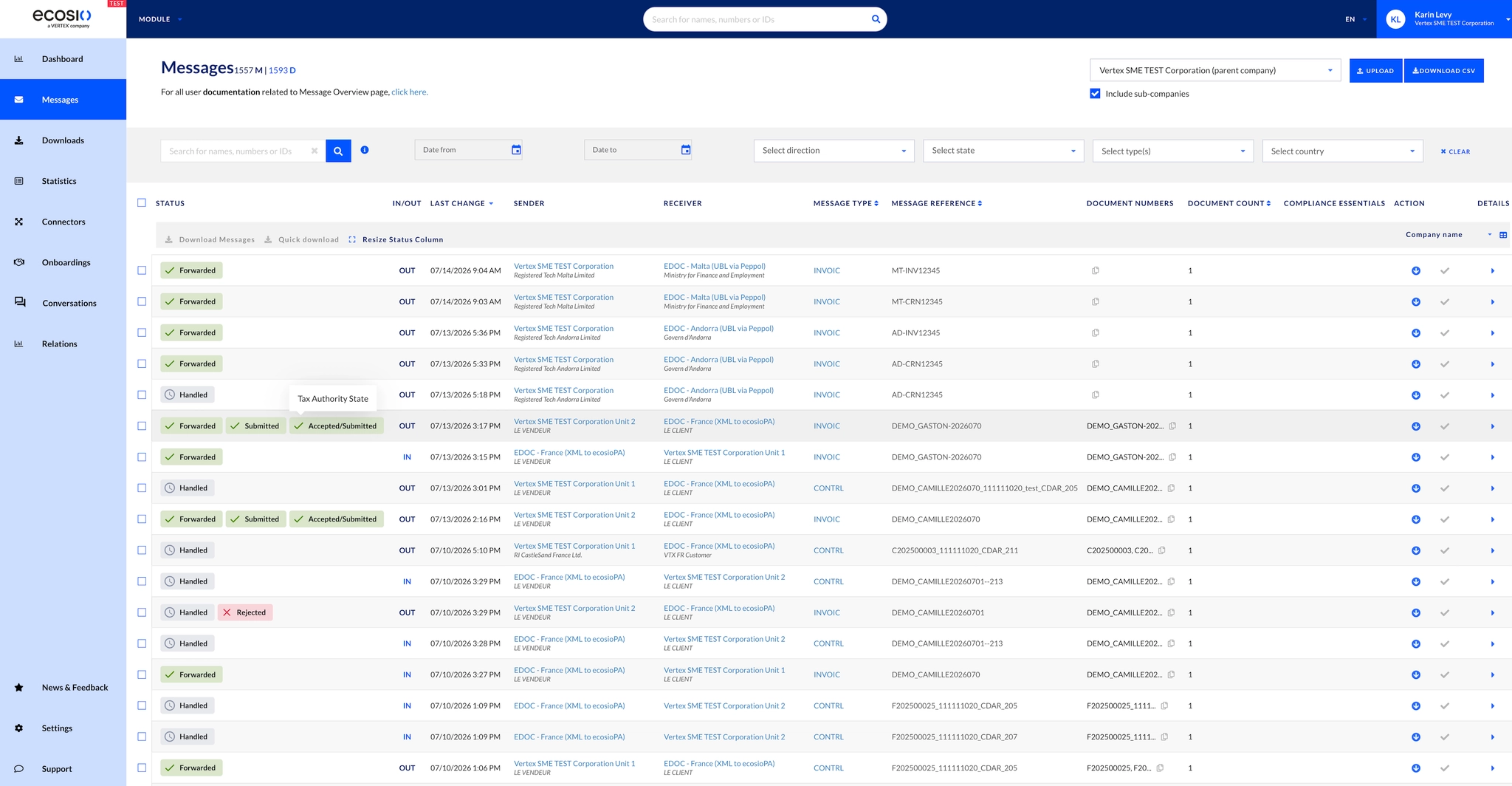
We have also completely redesigned the Connectors hub to give you total transparency over your technical setup. You can now see which connectors are in place, whether for your main account or across various sub-companies, and how they relate to specific country setups. With clear "Active" or "Ready for Setup" statuses and country flags, you no longer have to guess about the health or progress of your connections.

How this improves your world:

  • Cut through the global noise: Use country-specific views to catch incorrect VAT rates or missing fields before they disrupt your local production or delay a shipment.

  • Empower your regional teams: Native language support means local staff can troubleshoot blocked invoices independently, speeding up resolution times across different time zones.

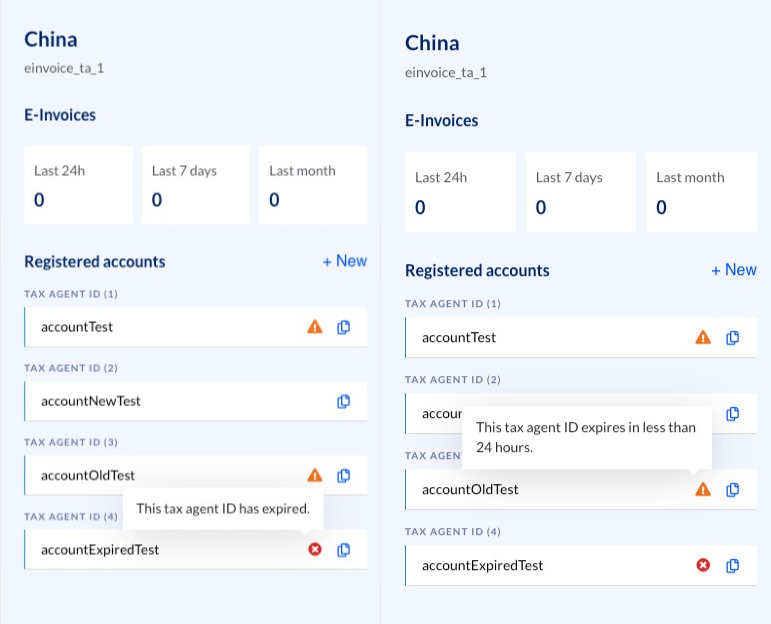
  • Configure with confidence: For self-service countries, a new step-by-step wizard guides you through adding credentials. This ensures your compliance setup is correct and "Active" from the very first try, with clear expiry countdowns to help you manage renewals before a connection expires.

Discover how ecosio simplifies global e‑invoicing compliance at ecosio.com or get in touch with our experts today. 

The ecosio product team

January 13th, 2026

General Public Documentation

Public

The latest version of the Monitor is designed to help you manage complex EDI and e-invoicing landscapes with greater ease. These updates focus on increasing user autonomy, improving transparency across borders, and providing the tools needed to scale your operations without increasing your manual workload.

Why this matters

As businesses expand into new markets, the "cognitive load" of managing different jurisdictions and hundreds of connections can become overwhelming. This update transforms the Monitor into a self-service hub where teams can resolve issues faster and maintain a consistent user experience across every region.

What’s new

Seamless Global Operations

Breaking down language and jurisdictional barriers is now easier than ever.

  • Native Language Support: the Monitor is now available in Spanish and French, allowing regional teams to work in their preferred language.

  • Country Filtering: A new country filter on messages allows you to isolate activity in specific regions, such as Hungary or Poland. By focusing on specific jurisdictions, teams can more easily identify country-specific errors and reduce the risk of missing critical compliance issues.

Country Filtering

Greater Autonomy & Self-Service

We’ve empowered users to take the lead on daily management tasks, reducing the need for back-and-forth support.

  • Flow User Management: You can now invite, edit, and deactivate Flow supplier users directly within the Monitor.

  • Activity Tracking: Maintain accountability with visibility into "Events," allowing you to track activity for specific users or across the whole company.

  • Redesigned Connector Hub: The Connectors page has been overhauled to provide a clearer view of ERP, Compliance, and soon Management API connections.

  • Guided Setup Wizard: A new step-by-step wizard guides you through compliance connector configurations, helping users activate their country connectors faster.

Scalability for ERP Partners

New tools help our partners manage large customer ecosystems from a single source of truth.

  • Centralized Customers Overview: Partners now have a dedicated tab to view all client environments, total connector counts, and assigned consultants at a glance.

  • Streamlined Troubleshooting: Consolidated visibility across all accounts allows for faster issue detection across your entire partner portfolio.

ERP Partner View

Technical Notes

  • Translation Scope: Interface menus and filters are translated; however, documentation and user-generated content remain in the original language.

  • Flow Management: Self-service user management is available for supplier companies that are not also standard clients of the Monitor.

Connector Counts: The Customers tab for partners displays all connectors (ERP & Compliance), while the Connector Overview focuses on API/SFTP and self-service compliance connectors.

The ecosio Product team

January 12th, 2026

Public

Working ahead of Greece’s myDATA and upcoming B2B e-invoicing requirements with Global E-invoicing Compliance (GEC)

Greece’s e-invoicing landscape is evolving fast. With myDATA already driving real-time reporting, and mandatory B2B e-invoicing approaching, you need a setup that keeps finance, tax, and IT aligned without adding more portals and country-specific workarounds.

With Global E-invoicing Compliance, ecosio is building Greece support so you can manage compliance through one platform.

Timeline

Greece’s B2B mandate is expected to roll out in phases:

  • 2 February 2026: Mandatory B2B e-invoicing for large companies with revenues exceeding EUR 1 million in the 2023 fiscal year

  • 1 October 2026: Mandatory B2B e-invoicing for all other businesses

ecosio roadmap

Greece is on our roadmap for 2026, with a current target for availability in Q1 2026. This is a target date, and we will keep you informed as technical and operational details are clarified.

The Greek mandate has an added level of complexity as compliance is not only about producing a structured invoice. It is about reporting, identifiers, delivery channels, and the operational reality of handling exceptions at scale.

That is why ecosio is building Greece support as a single, end-to-end flow under Global E-invoicing Compliance.

What ecosio provides in Greece (GEC):

  • Connect your ERP once and orchestrate the end-to-end Greece process

  • Validate invoice data, monitor statuses, and manage exception handling through one platform and service model

  • Report invoice data to myDATA, obtain the MARK, and deliver invoices to your customer through the required channel, including email for B2B and Peppol for B2G

What you can expect

With this approach, you can:

  • Reduce manual intervention,

  • Keep reporting and delivery consistent,

  • Avoid building a bespoke Greece solution in-house

What to do next

If Greece is on your roadmap, start planning now so you are ready for the February 2026 milestone.

For more context, visit our Greece e-invoicing page. If you want to discuss your scope (B2G, B2B, and myDATA alignment), get in touch with ecosio.

The ecosio Product team